- Ten Most Fascinating Websites
- Top 10 Digital Art Time Wasters
Listed here are the top ten interactive websites that are bound to suck you in with their addictive content. They are unique examples of contemporary internet art based on user interaction, and distinct from games in that there is no goal or win conditioning. One could contextually refer to them as “time-wasters”, but that would be an insult to digital art. I don’t know… Time-wasters or art, you be the judge.
-
WeaveSilk
WeaveSilk, often simply known as Silk, is a website that allows users to create colorful digital images on a black background. With Silk’s award-winning magic brush, anyone can be an artist. Featured by Apple as one of their favorite apps, Silk lets you relax, express yourself, and create mandalas and wallpapers. With the swish of a finger, Silk strands mingle and fuse, weaving together into wonderful works of digital art.

-
Feed the Head
Feed the Head, created by Vector Park, has been around for some time, and it stands for a piece of interactive entertainment of a type we don’t often see. It is more a digital interactive art installation than a game. It’s just plain fun to play. A piece of interactive art to be explored at your own pace. Spend a couple minutes or an hour. Lose yourself. Feed your head. Escape. Click.
-
Flow
Created by Han Hoogerbrugge, a Dutch digital artist known for his unique and eye-catching animation style so representative of MTV media era. Flow is an interactive tale of a contemporary man and his travels trough the landscapes of our time. Sometimes he goes up, sometimes he goes down. By the guidance of the frantic music from Gil Kay, we see the man struggle with faith and religion, sport and health care, stress, the power of medicine, gambling, death, identity, free floating and an eye-ball. It’s an interactive extravaganza.
-
Yenz
This site, created by German designer Jens Schmidt, was born from a ‘wish to create a webpage which allows things which are not usual for the Web, such as full-screen animations and big images, without the problem of bad Web resolution’. As you enter you will find there are many ways to explore and play.
-
Bomomo
Bomomo is another cool art generator that runs in your browser. Select one of the dynamic brushes and start playing around, shortly after, you are likely to end up with your very own piece of digital art.
-
This Sand
Designed by Johanna Lundberg and Jenna Sutela in collaboration with the Flash programmer Timo Koro, this website is a playground of colours and sound for people to play with. It is a sandbox – within the computer screen. With a simple click of the mouse, you can change the pixels on the screen into digital sand that can be used as building material for cosmic landscapes, Clemens-style sand paintings, mandalas and so on. Sometimes the resulting pieces are expressive, sometimes they become more abstract. And just as a real world sandbox, the digital one can be smoothed out and re-sculpted again time after time.
Just like the actual sand gets its colour from its origins, the sand used on thisissand.com covers the RGB palette natural to digital environments. Also the sounds of the falling sand on thisissand.com resemble a real life phenomenon: singing sand is discovered in about 35 desert locations around the world where the wind triggers a low-pitch sound in the natural sand. Instead of nature’s frequencies the digital sand generates white noise, which is a random signal with a flat power density. It is considered analogous to white light which contains all frequencies – like the RGB sand on thisissand.com.
The specialities of the digital sand lie in the possibility of saving the original pieces of sand art in the gallery or printing them out.

-
Kaleidoscope
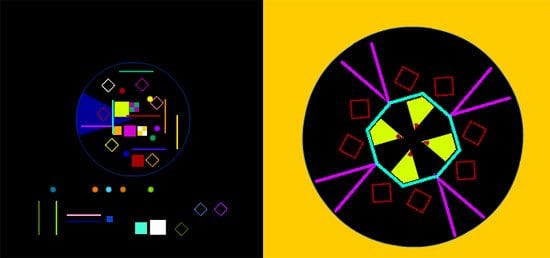
A great online time-waster, virtual kaleidoscope was created by Ze Frank, an American web designer who likes to combine technology and art in his work. Remember the awe you felt the first time you looked through the kaleidoscope lens? The virtual version is more addictive and it works without holding it up and pointing it towards the light. Just drag the shapes and colors onto the rotating wedge and you’ll see the kaleidoscopic patterns appear in color.
-
Omm
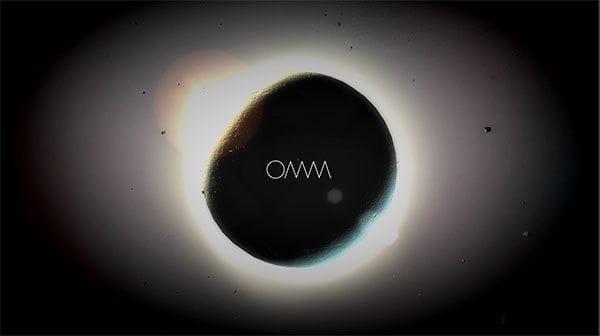
OMM is an Interactive Audio Visual Experience exploring different phases of creativity. Made possible by Three.js
-
Dream Lines
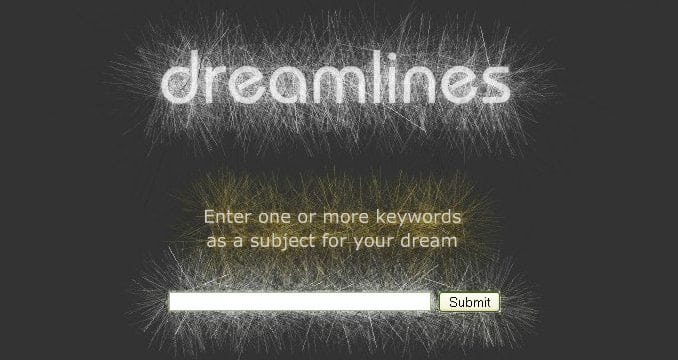
Dreamlines is a non-linear, interactive visual experience, a project by Leonardo Solaas. The user enters one or more words that define the subject of a dream he would like to dream. The system looks in the Web for images related to those words, and takes them as input to generate an ambiguous painting, in perpetual change, where elements fuse into one another, in a process analogous to memory and free association. The pictures are never actually shown. The drawing itself is produced by 1500 autonomous particles in perpetual movement. The last image loaded serves as a sort of virtual terrain for them. The direction and speed of each particle is given, at each step, by the color values of the pixel they are stepping on. Different sets of formulas translate the hue, saturation and brightness of the pixel in angle and velocity values for the particle. The path of each particle is traced to the screen, and this forms the output seen by the user.
Thus, the work is at the same time a study on population dynamics, or on the emergent behavior of a multitude of very simple autonomous agents. Who is dreaming? The user, or the Internet itself? In a certain way, both. The program generates a personal moving picture, unique, unpredictable, and forever gone when it is finished, just like dreams. But that dream is made out of pieces taken form the subconscious of the whole net, gathered by some words of the user and the obscure logic of searching algorithms.
The subject of this work is, many times, multiplicity. That of the particles in endless movement, that of the vast contents of the Internet, that of the users and the dreams they wish to dream. All this multiplicities get together on the verge of chaos, on a process that mixes randomness and strict but complex logics, very much alike the processes that take place in our heads. Even when we rest.
-
Celestia
Celestia is an amazing free space simulation that lets you see the universe in three dimensions. The exponential zoom feature allows the user to explore space across a huge range of scales seamlessly. A ‘point-and-go-to’ interface makes it simple to navigate through the universe to the object you want to visit. You can travel throughout the solar system, to any of over 100,000 stars, or even beyond the galaxy. Celestia comes with a large catalog of stars, galaxies, planets, moons, asteroids, comets, and spacecraft. It runs on Windows, Linux, and Mac OS X.




 About Dubie Bacino








I LOVE THIS LIST!! I WAS LOOKING FOR THIS KIND OF STUFF BUT JUST DIDN’T KNOW WHAT TO CALL IT AND HOW TO FIND IT!! ART, DIGITAL ART FOR SURE:)
Hi this is a fantastic post. I love running into fun stuff like this, internet is amazing!
These are really awesome web sites. I had time to browse through some of them, but I bookmarked your post to come back and check them all out when I have more time to kill. Thanks.
I just could not leave before letting you know I really like the posts here … Will be back often to check for new top lists.
There is obviously a lot for me to discover outside of my books. Thanks for the great read 🙂
thank you verry much for nice post
Great site. I just found it today and I enjoyed it. I will check back for updates.
I truly appreciate this post. I ve been looking everywhere for this! Thank goodness I found it on Bing. You ve made my day! Thank you again! “That which does not kill us makes us stronger.” by Friedrich Nietzsche….